


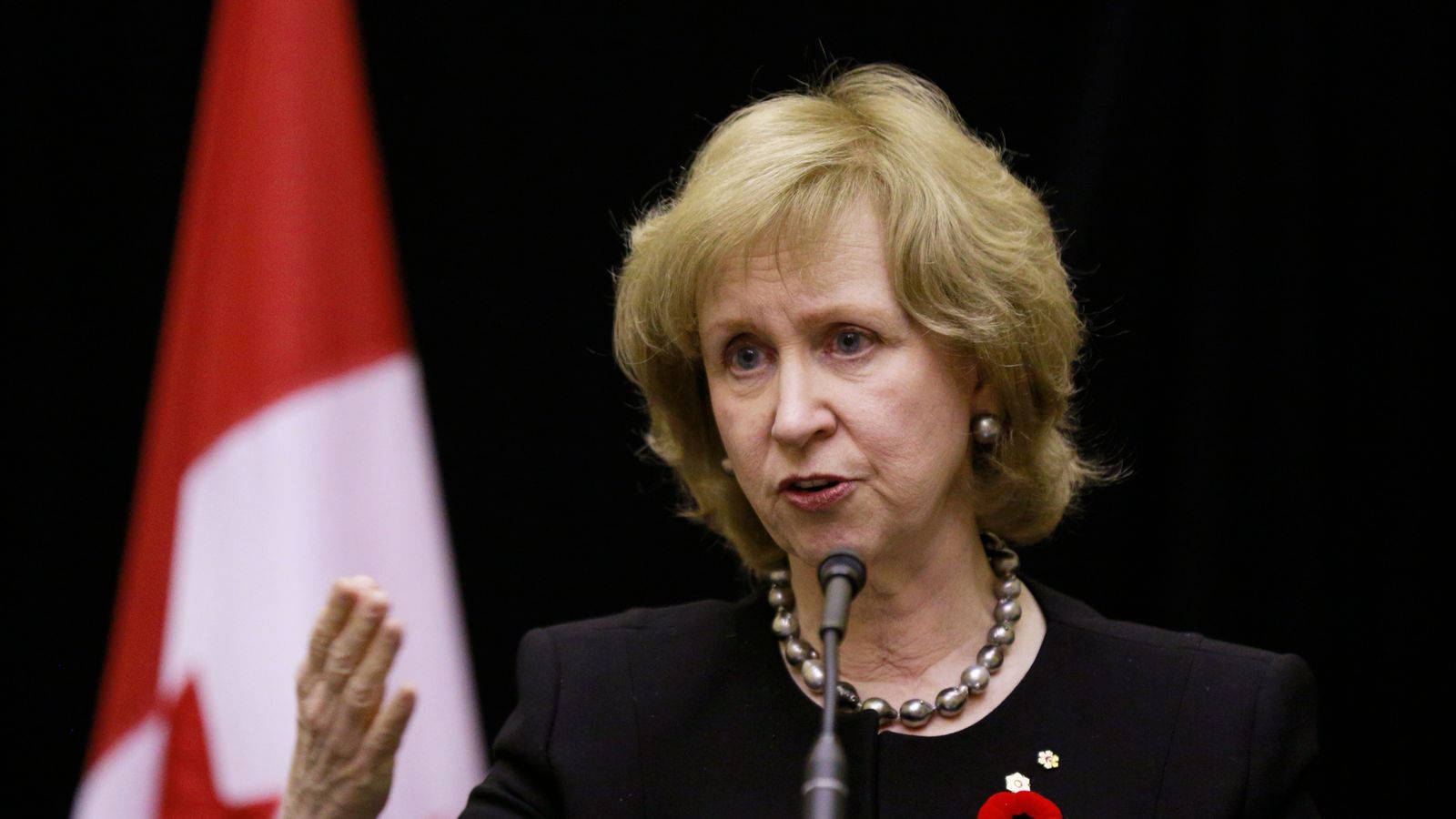
Avril Phaedra Douglas Campbell, known professionally and publicly as Kim Campbell, was born on March 10, 1947, in Port Alberni, British Columbia.
She is a Canadian lawyer, professor, politician, diplomat, and advocate who holds a unique place in the nation’s history as the first and only woman to serve as prime minister of Canada.
She held the office from June 25 to November 4, 1993, becoming the 19th prime minister and the first from British Columbia as well as the first baby boomer to lead the country.
Her parents were Phyllis “Lissa” Margaret Cook and George Thomas Campbell, a barrister and World War II veteran who had served with the Seaforth Highlanders of Canada.
As a teenager she adopted the nickname Kim, which she has used ever since.
She was a high-achieving student who became the first female student council president at Prince of Wales Secondary School, served as valedictorian, and later earned an honours bachelor’s degree in political science from the University of British Columbia in 1969.
Siblings
Kim has one sibling, an older sister named Alix, who was born in 1945.
The two sisters were raised together by their father after their mother left the family when Campbell was twelve years old.
They did not see their mother again for approximately a decade following the divorce.
Career
Campbell’s professional path combined academia, law, and politics.
After returning from London she taught political science part-time at the University of British Columbia and Vancouver Community College.
While still in law school she entered public life as a trustee on the Vancouver School Board from 1980 to 1984, serving as chair in 1983.
She practised law briefly in Vancouver before joining the office of British Columbia Premier Bill Bennett as an executive assistant and policy adviser.
In 1986 she was elected to the British Columbia Legislative Assembly as a Social Credit member for Vancouver-Point Grey.
Also Read: Neville Chamberlain Siblings: Getting to Know the Chamberlain Siblings
Disillusioned with the provincial party leadership, particularly over issues of principle, she left provincial politics and won a seat in the House of Commons as a Progressive Conservative for Vancouver Centre in the 1988 federal election.
Under Prime Minister Brian Mulroney she advanced rapidly through cabinet, serving first as minister of state for Indian Affairs and Northern Development, then as Canada’s first female minister of justice and attorney general from 1990 to 1993.
In that role she advanced reforms related to gun control and sexual assault law.
In early 1993 she became the first woman to serve as minister of national defence and minister of veterans affairs, and the first woman to represent a NATO member country at a defence ministers’ meeting.
When Mulroney resigned, Campbell won the Progressive Conservative leadership and was sworn in as prime minister on June 25, 1993.
Her government reduced the size of cabinet and participated in international meetings, including the G7 summit, yet the party suffered a historic defeat in the October 1993 federal election, winning only two seats.
Campbell herself lost her riding.
After leaving office she served as Canadian consul general in Los Angeles from 1996 to 2000, taught at the Harvard Kennedy School of Government, chaired the Council of Women World Leaders, and served as secretary general of the Club de Madrid.
Accolades
Campbell was appointed a Companion of the Order of Canada in 2008 (invested in 2010) for her distinguished service to Canadian politics and her work promoting global democracy, international cooperation, and the advancement of women in politics.
In 2012 she was invested into the Order of British Columbia.
She has received the Queen Elizabeth II Golden Jubilee Medal and the Queen Elizabeth II Diamond Jubilee Medal.
Among other distinctions are the Chatelaine Magazine Woman of the Year award in 1994, induction into the International Women’s Forum Hall of Fame in 2008, the Churchill Society Award of Excellence in 2008, the Women in Law Leadership Lifetime Achievement Award in 2015, the Vancouver Metro YWCA Icon Award in 2018, and lifetime achievement awards from the University of British Columbia’s Peter Allard School of Law Alumni Association and Global Woman of Vision, both in 2018.
She holds numerous honorary doctorates, including degrees from the Law Society of Upper Canada, Brock University, the University of British Columbia, the University of Alberta, Trent University, Simon Fraser University, Acadia University, and several American institutions.

Email your news TIPS to Editor@Kahawatungu.com — this is our only official communication channel
