


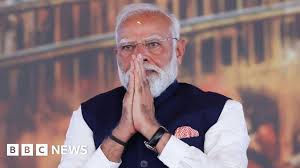
Prime Minister Narendra Modi has appealed to Indians to revive working from home, buy less gold and limit foreign travel to deal with a surge in global energy prices because of the continuing crisis in the Middle East. Modi said the austerity measures, reminiscent of the Covid era, would reduce India’s fuel use and help save foreign exchange.
India imports 90% of its oil and its crude bill has seen a multi-billion dollar spike since the US and Israel’s war on Iran, with the Strait of Hormuz, a narrow Gulf chokepoint, shut for more than two-and-a-half months now.
Analysts described Modi’s appeal, made at a public event in the southern city of Hyderabad on Sunday, as the “most drastic” so far.
“Patriotism is not only about the willingness to sacrifice one’s life on the border. In these times, it is about living responsibly and fulfilling our duties to the nation in our daily lives,” Modi said.
“In the current situation, we must place great emphasis on saving foreign exchange,” he added.
Urging people to use public transport such as the metro, Modi suggested people carpool to conserve fuel. He also asked farmers to reduce use of fertiliser by half.
The effect was visible on Indian markets on Monday – analysts say Modi’s comments was one of the reasons the benchmark Sensex index fell more than 1,000 points in early trade amid fears of prolonged economic disruption.
India has so far avoided raising petrol and diesel prices at the pump despite mounting pressure on state-run fuel retailers. But the prolonged conflict and disruption to oil supplies have begun to strain the broader economy.
The impact has been visible in a number of industries, with hundreds of thousands of jobs at risk in factories that make glass and plastic products and tiles. Dwindling fertiliser supplieshave raised concerns about lower farm produce and higher food prices.
But the effect has been most stark on the Indian rupee, which has hit record lows in recent weeks, increasing the cost of imports and adding pressure on inflation.
Analysts say Modi’s remarks indicate the government may soon issue some directives to curb energy use. A price revision of petroleum products could also be on the horizon.
India’s opposition leaders criticised Modi’s remarks, saying it pointed to poor planning on the part of the federal government.
Congress party leader Rahul Gandhi said the government was shifting “responsibility onto the people” and escaping accountability themselves.
“[Modi’s suggestions] aren’t sermons – these are proofs of failure,” he said in a post on X.
The war in Iran and the choking of the Strait of Hormuz has affected economies across the globe, especially in Asia, with many countries reeling under rising fuel costs. The International Energy Agency (IEA) has described it as the “largest supply disruption in history”.
In the days following the start of the war, a number of countries introduced measures to limit the impact on consumers and the economy.
China ordered its oil refineries to stop exporting fuel for the time being, but petrol still became expensive in the country and some Chinese airlines cut flights as jet fuel prices went up.
Some Australian states have made public transport free or slashed fares by half to encourage people not to drive.
The Philippines declared a national emergencyin March, with its government offering subsidies to transport drivers, reducing ferry services and implementing a four-day work week for civil servants.
Sri Lanka too introduced fuel rationing and temporarily turned to a four-day week, shutting down schools, colleges and other government institutions on Wednesdays.
By BBC News

Email your news TIPS to Editor@Kahawatungu.com — this is our only official communication channel
