


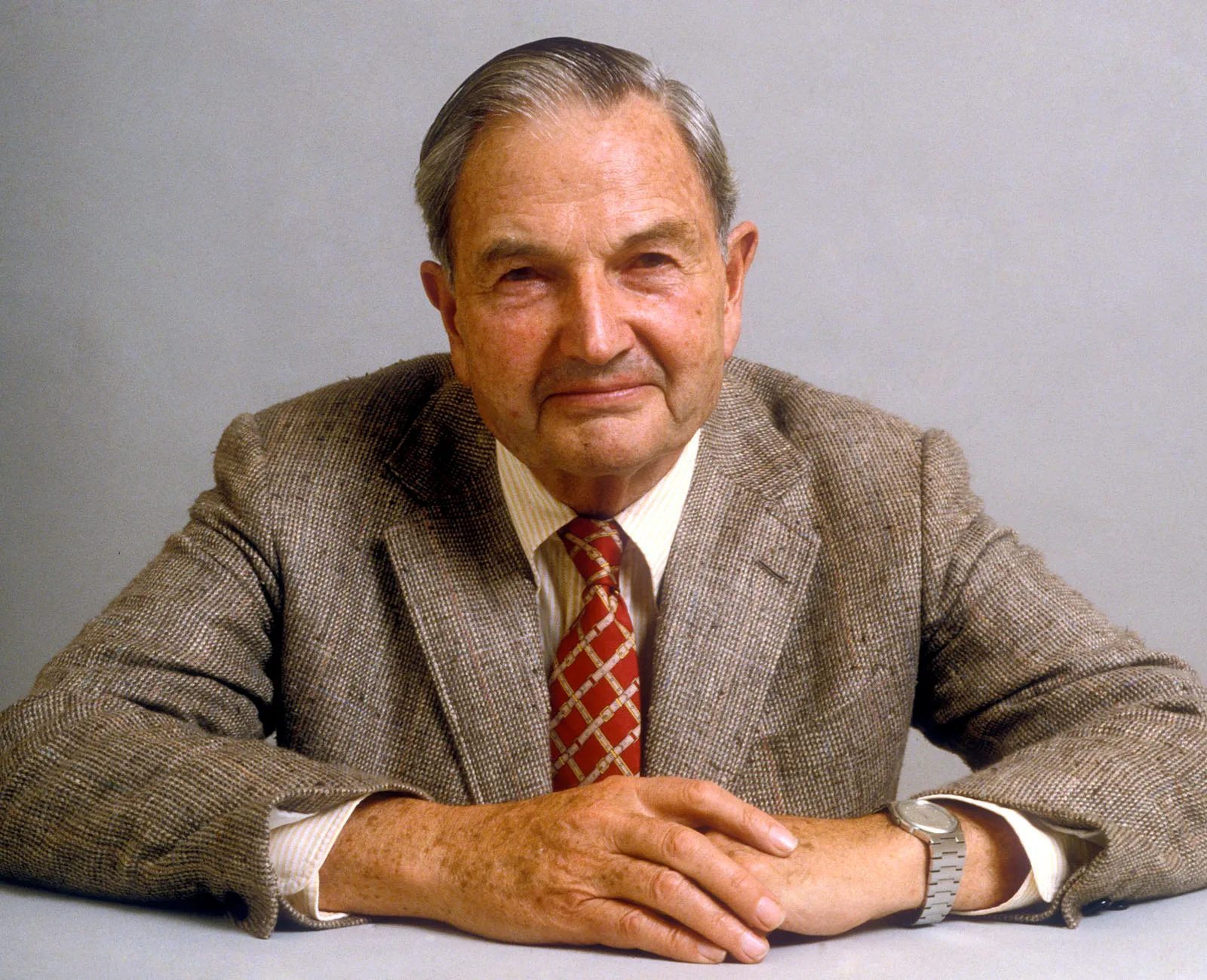
David Rockefeller’s estimated net worth of $2.9 billion reflected his inheritance, investments and long association with one of America’s wealthiest families.
His fortune originated with his grandfather, John D. Rockefeller, who founded Standard Oil and became one of the richest people in modern history. John D. Rockefeller’s wealth was distributed among his descendants through family trusts, investments and other financial arrangements.
David did not build his fortune through a single business venture. Instead, he benefited from the Rockefeller family’s extensive wealth while developing his own career in banking and finance.
When he entered the banking industry, the family name already carried considerable influence in American business. Over the years, he gained senior positions at Chase Manhattan Bank and became one of the most influential bankers of his generation.
Much of his wealth was held through investments and family financial arrangements. His fortune also supported an extensive portfolio of philanthropic activities, including major donations to universities, museums and research institutions.
| David Rockefeller Net Worth | $2.9 Billion |
| Date of Birth | June 12, 1915 |
| Place of Birth | New York City |
Early Life
David Rockefeller was born on June 12, 1915, in New York City. He was the fifth son and youngest child of John D. Rockefeller Jr. and Abby Aldrich Rockefeller. His siblings were Abby, John III, Nelson, Laurance and Winthrop.
His grandfather, John D. Rockefeller Sr., founded Standard Oil and established the family’s enormous fortune. His father, John D. Rockefeller Jr., became a prominent philanthropist and played a major role in developing Rockefeller Center in Manhattan.
David grew up in a wealthy household but was raised with an emphasis on education, philanthropy and public responsibility. His father reportedly encouraged his children to divide their allowances between spending, saving and charitable giving.
He attended the Lincoln School in New York before enrolling at Harvard University. He graduated cum laude in 1936 and later studied economics at the London School of Economics.
After returning to the United States, Rockefeller continued his education at the University of Chicago, where he earned a doctorate in 1940.
His academic background in economics and international affairs helped prepare him for a career that would involve global banking, international business and public service.
Military Service
After completing his studies, Rockefeller worked in public administration. He became a secretarial intern under New York City Mayor Fiorello La Guardia before taking up a position with the US Office of Defense, Health and Welfare Services.
In 1943, during World War II, he enlisted in the United States Army. He served in military intelligence in North Africa and France and later worked as an assistant military attaché at the American Embassy in Paris.
Rockefeller rose to the rank of captain before leaving the military in 1945.
His wartime experience exposed him to international affairs and government operations. These connections later became useful during his career in global banking, where relationships with foreign governments and business leaders were important.
Career at Chase Manhattan Bank
After the war, Rockefeller joined Chase National Bank, which had longstanding connections to his family. His uncle, Winthrop W. Aldrich, was chairman of the bank at the time.
He began as an assistant manager in the foreign department, where he worked on financing international trade involving commodities such as coffee and sugar.
In 1955, Chase National Bank merged with the Manhattan Company to form Chase Manhattan Bank. The merger expanded the institution’s operations and strengthened its position in the American banking industry.
Rockefeller steadily rose through the organisation. He became president of Chase Manhattan Bank in 1960 and later assumed the positions of chairman and chief executive.
Under his leadership, the bank expanded its international presence and became an important institution in global finance. It developed relationships with businesses and governments around the world, strengthening its role in international banking.
His tenure was not without challenges. Chase faced financial difficulties during the 1970s, including losses from troubled loans. The bank was described as a problem bank by the Federal Reserve in 1975.
However, its earnings recovered later in the decade. Rockefeller remained chairman until 1981 and retired from active management after helping establish Chase Manhattan as a major international financial institution.
Political Connections
David Rockefeller was widely known for his relationships with political leaders, business executives and influential figures across the world.
His banking career required frequent international travel and meetings with government officials. Over the years, he developed relationships with American presidents and foreign leaders, including Dwight D. Eisenhower, Jimmy Carter, Fidel Castro, Saddam Hussein and Mikhail Gorbachev.
He also maintained a close relationship with former US Secretary of State Henry Kissinger, who served on the board of trustees of the Rockefeller Brothers Fund.
Rockefeller’s international relationships sometimes attracted criticism. His meetings with controversial political leaders raised questions about the relationship between international banking, American foreign policy and business interests.
He also had connections with senior figures in the Central Intelligence Agency, including former director Allen Dulles. His relationships with intelligence and government officials reflected the influence he held in international political and financial circles.
Philanthropy
Philanthropy was a major part of David Rockefeller’s life. He supported education, healthcare, scientific research, the arts and international development.
In 1964, he co-founded the International Executive Service Corps, an organisation established to encourage private enterprise and economic development in developing countries.
In 1965, he founded the Americas Society, which sought to strengthen understanding and cooperation between the United States and other countries in the Americas.
He also co-founded the Trilateral Commission in 1973. The organisation brought together influential leaders from North America, Western Europe and Japan to encourage cooperation on international economic and political issues.
In 1979, Rockefeller founded the New York City Partnership, a private-sector organisation that brought together business leaders to support the city’s economic development.
His charitable giving continued throughout his life. In 2005, he donated $100 million to the Museum of Modern Art in New York and another $100 million to Rockefeller University. He also supported Harvard University and Colonial Williamsburg.
His estate later made a major donation to the Museum of Modern Art, continuing his longstanding support for the institution. He also pledged substantial resources to the Rockefeller Brothers Fund to support projects involving healthcare, international trade and sustainable development.
These contributions helped establish him as one of the most prominent philanthropists of his generation.
Real Estate
David Rockefeller’s wealth also included an extensive collection of residential and investment properties.
His principal residence was located in Pocantico Hills, New York, on the Rockefeller family estate. The property was part of the family’s historic holdings and reflected its longstanding presence in the Hudson Valley.
He also maintained residences in Manhattan and Livingston, New York. His other properties included a summer home on Mount Desert Island off the coast of Maine and an estate on the Caribbean island of Saint Barthélemy.
Beyond his personal residences, Rockefeller had interests in other property ventures, including a resort development in the Virgin Islands, a cattle ranch in Argentina and a sheep ranch in Australia.
He was also an art collector and supported museums and cultural institutions throughout his life. His interest in the arts reflected a wider family tradition of cultural patronage.
The Rockefeller Family Legacy
David Rockefeller belonged to one of America’s most influential business and philanthropic families.
His grandfather, John D. Rockefeller, founded Standard Oil and became one of the richest individuals in history. His father, John D. Rockefeller Jr., continued the family’s philanthropic work and became associated with major cultural and development projects, including Rockefeller Center.
His brothers also held influential positions in business, politics and public life. Nelson Rockefeller served as governor of New York and vice president of the United States, while Winthrop Rockefeller became governor of Arkansas.
Another brother, Laurance Rockefeller, was a prominent venture capitalist and conservationist. John D. Rockefeller III was known for his work in philanthropy and international development.
David became the family patriarch following the deaths of his brothers. He helped oversee the family’s business and charitable interests while continuing its tradition of supporting education, healthcare and the arts.
Despite the family’s association with Republican politics, David maintained relationships across the political spectrum and was known for his interest in international cooperation.
Marriage
David Rockefeller married Margaret McGrath in 1940. She was an environmental conservationist and remained his wife until her death in 1996.
The couple had six children: David Jr., Abby, Neva, Peggy, Richard and Eileen. Their children became involved in various business, cultural and philanthropic activities.
Rockefeller’s family life was closely connected to the wider Rockefeller family’s charitable and business interests. His children and grandchildren continued to participate in philanthropic initiatives and other activities associated with the family.
Retirement and Death
David Rockefeller retired from his position as chairman of Chase Manhattan in 1981, bringing an end to one of the most influential periods of his banking career.
Although he stepped away from daily banking operations, he remained active in philanthropy, international affairs and the management of family interests.
He continued supporting educational institutions, museums and development organisations. His public appearances and international engagements also kept him connected to business and political leaders around the world.
David Rockefeller died on March 20, 2017, at his home in Pocantico Hills, New York. He was 101 years old. He died in his sleep from congestive heart failure.
His death marked the passing of the oldest living member of the third generation of the Rockefeller family.
Also Read: Jay Rockefeller Net Worth

Email your news TIPS to Editor@Kahawatungu.com — this is our only official communication channel
