


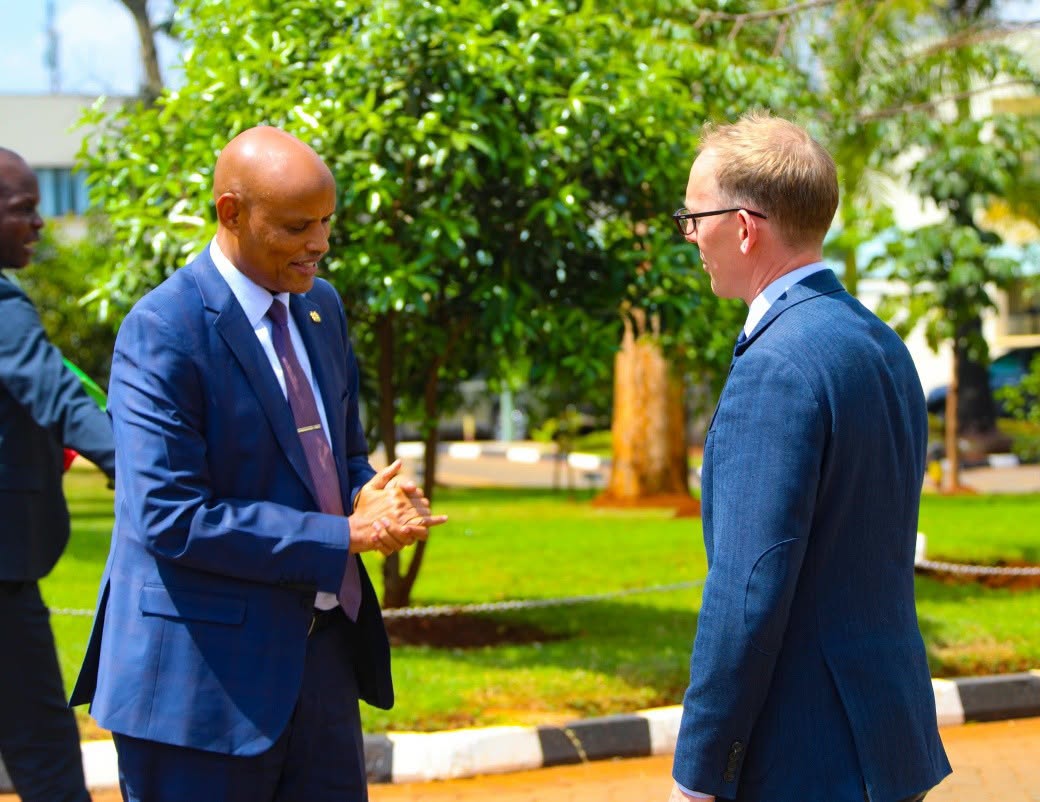
The Directorate of Criminal Investigations (DCI) has received a fleet of operational vehicles donated by the United Kingdom Government to strengthen Kenya’s fight against human trafficking, migrant smuggling and other cross-border crimes.
The vehicles were donated through the British High Commission in Kenya under the East Africa Border Security Programme.
The handover took place at the DCI headquarters on Wednesday and was marked by the signing of a Memorandum of Understanding (MoU) between the two countries.
DCI Director Mohamed Amin and British High Commissioner to Kenya Matt Baugh OBE officially flagged off the vehicles following the handover ceremony.
Speaking during the ceremony, Baugh said the donation demonstrated the shared commitment by Kenya and the UK to disrupt criminal networks operating across East Africa.
“Organised immigration crime is a shared threat. It exploits the most vulnerable, undermines lawful migration and funds wider organised crime,” Baugh said.
He said the vehicles would improve the ability of the Counter Organised Immigration Crime Team to conduct investigations and operations targeting criminal networks.
“These vehicles will give the Counter Organised Immigration Crime Team the reach it needs to investigate, intercept and dismantle those networks,” he said.
Baugh stressed that the partnership between Kenya and the UK should translate into tangible results, including safer borders, protection of victims and successful prosecution of suspects.
“Partnership only matters if it produces results on the ground — safer borders, protected victims and successful prosecutions. That is the standard we will hold ourselves to together,” he said.
The British High Commissioner also commended Kenyan investigators for their professionalism and reaffirmed the UK’s long-term commitment to the East Africa Border Security Programme.
The programme is implemented in partnership with organisations including Mercy Corps and Valar.
Amin described the handover as a significant milestone in the longstanding security partnership between Kenya and the UK.
He said the cooperation had strengthened Kenya’s institutional capacity to respond to emerging security threats and transnational organised crime.
The DCI director said criminals were becoming increasingly sophisticated, with human trafficking, migrant smuggling and document fraud among the crimes requiring stronger cross-border cooperation.
He said tackling such crimes required intelligence sharing and coordinated action between law enforcement agencies and other stakeholders.
“The growing complexity of crimes such as human trafficking, migrant smuggling, document fraud and other cross-border criminal activities requires strong partnerships, intelligence sharing and coordinated action,” Amin said.
Amin said the vehicles would significantly enhance the operational capabilities of the specialised Counter Organised Immigration Crime Team.
The additional vehicles are expected to enable investigators to respond more quickly to cases, conduct field operations efficiently and pursue criminal networks operating within Kenya and across its borders.
The DCI director said the agency would use the resources responsibly to strengthen investigations and improve the protection of vulnerable people affected by organised crime.
He also said the support would contribute to successful prosecution of individuals involved in transnational criminal activities.
Amin thanked the UK Government, the British High Commission and implementing partners for their continued support towards strengthening Kenya’s law enforcement capabilities.
He particularly acknowledged Mercy Corps representatives Sarah Gibbons and Allison Higgins, as well as Valar, for their contribution to the programme.
The ceremony concluded with the official flagging off of the vehicles by Amin and Baugh.
The event was also attended by Ben Fisher of the East Africa Border Security Programme and Joaana Oser from Valar.

Email your news TIPS to Editor@Kahawatungu.com — this is our only official communication channel
