


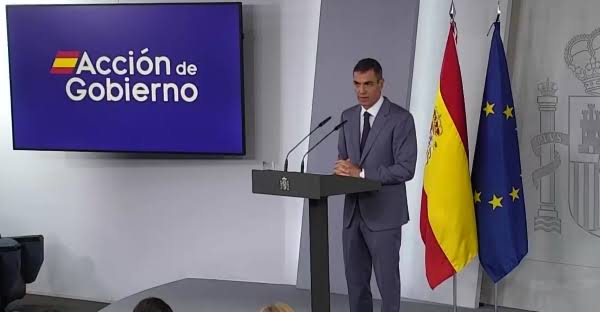
Spain went to the polls on November 29, 2026, in a snap election that could end Prime Minister Pedro Sánchez’s eight-year run. The early returns tell a clear story: voters are deeply divided, and the center-left is on the ropes.
What makes this election fascinating isn’t just the tight race—it’s the paradox driving it. On paper, Spain’s economy is the envy of Europe. In practice, voters are opening their wallets and feeling nothing but the pinch.
Turnout hit a staggering 79%, the highest electoral participation in 40 years. Spaniards showed up.
With early results trickling in, Alberto Núñez Feijóo’s center-right People’s Party (PP) is leading the count. Pre-election surveys projected the PP to win 131–136 seats, while the far-right Vox party was slated for 44–48 seats. Combined, that puts the right-wing bloc right at or above the 176 seats needed for a majority in the 350-seat lower house.
Sánchez’s Socialist Party (PSOE) is projected to fall short, landing between 119 and 124 seats, with the left-wing Broad Front adding only 10–11 more. The math is tight, but the momentum is clearly shifting.
Why would voters oust a government overseeing such strong numbers? Because macroeconomic success doesn’t always translate to kitchen-table reality.
Under Sánchez, Spain has topped growth among advanced economies for three straight years and created roughly 41% of all new jobs in the EU last year. The national deficit has narrowed.
But Spaniards aren’t feeling it. Inflation hit 4.9% in October, the highest since early 2023. Housing, energy, and consumer goods have become prohibitively expensive. While salary reforms helped millions of workers, they also squeezed the small businesses that make up 95% of Spain’s companies. Per capita income still lags behind the EU average, and the share of the population at risk of poverty or social exclusion has barely budged in a decade.
As Salvador Illa, a leading Socialist, recently admitted: the economy is working in macroeconomic terms, but that prosperity is not being shared adequately.
The opposition is capitalizing on this frustration with a mix of populist promises and hardline rhetoric.
The PP has pledged to raise Spain’s average salary from around €29,500 to €50,000, though they have yet to provide a concrete mathematical roadmap for how to achieve it. They are also pushing stricter immigration policies and financial aid for young families trying to buy homes, directly targeting the country’s severe housing crisis.
Vox, meanwhile, is proposing sweeping tax cuts. They claim this will be paid for by stripping political parties and unions of public funding, and by restricting welfare payments exclusively to Spanish citizens. Their campaign has heavily blamed immigration for the country’s economic woes, a message that appears to be resonating with a frustrated electorate.
On the ground, the divide is stark. In Madrid, Barcelona, and Andalusia, voters expressed two entirely different fears. Some are voting to protect social gains and democratic norms, wary of a far-right return to power for the first time since the end of Franco’s dictatorship. Others are voting purely on economic survival, frustrated by a government they feel has governed poorly and left them behind.
Sánchez campaigned heavily on the fear of a far-right coalition, urging a historic mobilization. He got the turnout, but the early vote share suggests it wasn’t enough to hold the line.
As the final votes from the Canary Islands are tallied and coalition math begins, Spain is bracing for a potential political earthquake. The economy might be growing, but in 2026, Spanish voters decided that growth alone is no longer enough to keep the lights on

Email your news TIPS to Editor@Kahawatungu.com — this is our only official communication channel
