


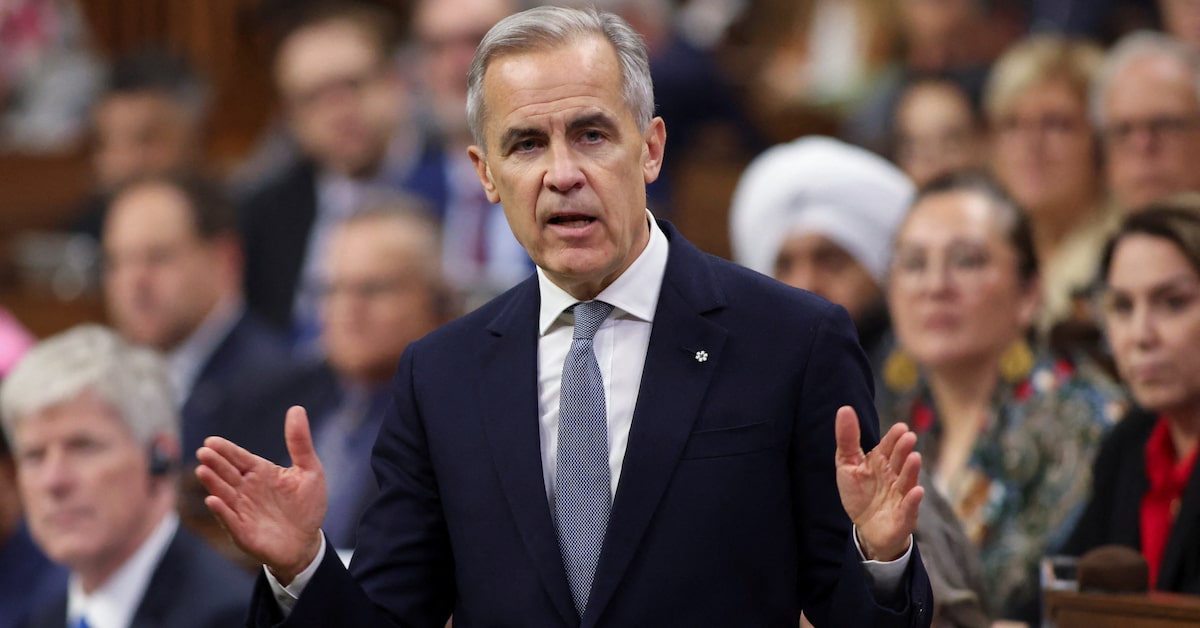
Canada’s parliament has narrowly approved Prime Minister Mark Carney’s first federal budget, allowing his minority Liberal government to avert an early election.
The fiscal plan, which raises Canada’s deficit to a projected C$78 bn ($55.3 bn; £42.47 bn), was passed thanks to crucial support fromopposition MPs, including Green Party leader Elizabeth May.
Many opposition lawmakers have sharply criticised the fiscal plan – the second largest in history. The plan passed with 170 votes in favour and 168 against it.
Carney, who served as the former central banker for both Canada and the UK, has defended the budget as a “generational investment” to help Canada strengthen its economy.
The vote was crucial for Carney’s Liberal government, which currently sits two seats short of a majority.
It meant that if all 169 Liberal MPs voted in support, the budget would need the backing from either two opposition MPs, or have four opposition MPs abstain.
Two NDP MPs abstained along with House Speaker Francis Scarpaleggia, who casts a vote in the event of a tie. Conservative MPs Shannon Stubbs and Matt Jeneroux – who announced earlier this month that he was resigning – also abstained.
Green Party leader Elizabeth May’s support also proved crucial. May told reporters she voted yes based on commitments made by Carney that he would support Canada’s climate targets.
“Without what I heard from the Prime Minister today, I would have voted no,” she said.
The Conservative Party, led by Pierre Poilievre, and the Quebec nationalist Bloc Québécois both voted against the budget, accusing Carney’s government of failing to address affordability concerns.
Poilievre labelled the budget a “credit card budget”, arguing it does little to tackle the cost-of-living crisis.
“The Prime Minister’s costly deficit gambles our future on the national credit card,” Poilievre said in the House of Commons on Monday ahead of the vote.
Liberal MP Nathaniel Erskine-Smith, who supported the budget, raised concerns of his own, suggesting that while the plan offered much-needed investment, it fell short in addressing Canada’s housing crisis and stalled progress on climate action.
The budget proposes C$140bn of new spending over the next five years “to strengthen Canada’s productivity, competitiveness, and resilience”.
It includes money to update ports and other trade infrastructure with the goal of doubling Canadian exports to non-US markets over the next decade.
Additionally, the plan allocates direct support for businesses hurt by US tariffs on Canadian goods, with Carney’s government projecting the initiatives will attract C$1 trillion in private sector investment over the next five years.
To balance the fiscal plan, Carney has proposed cutting the federal workforce by 10% over the coming years – a move that has drawn strong criticism from public sector employees, who cautioned that a leaner federal workforce would slow government operations.
The budget was first put forward in early November, and has already survived two votes.
Debate around it had been partially eclipsed by partisan drama between Carney’s Liberals and the Conservative opposition, who lost a member of their caucus to the Liberals shortly after the fiscal plan was proposed.
Chris d’Entremont of Nova Scotia said he defected over what he believed was Conservative leader Pierre Poilievre’s “negative” style of politics. He added that the Liberal budget “hits the priorities” of his constituents.
Another Conservative lawmaker, Matt Jeneroux of Alberta, later resigned from parliament that same week, saying he did so to spend more time with family.
The departures fuelled questions about Poilievre’s leadership. On Wednesday, he told reporters that he plans to stay on as leader.
“My plan is to continue to lead and be the only leader that’s fighting for an affordable Canada where our people who work hard can afford a home and food,” Poilievre said.
By BBC News

Email your news TIPS to Editor@Kahawatungu.com — this is our only official communication channel
