


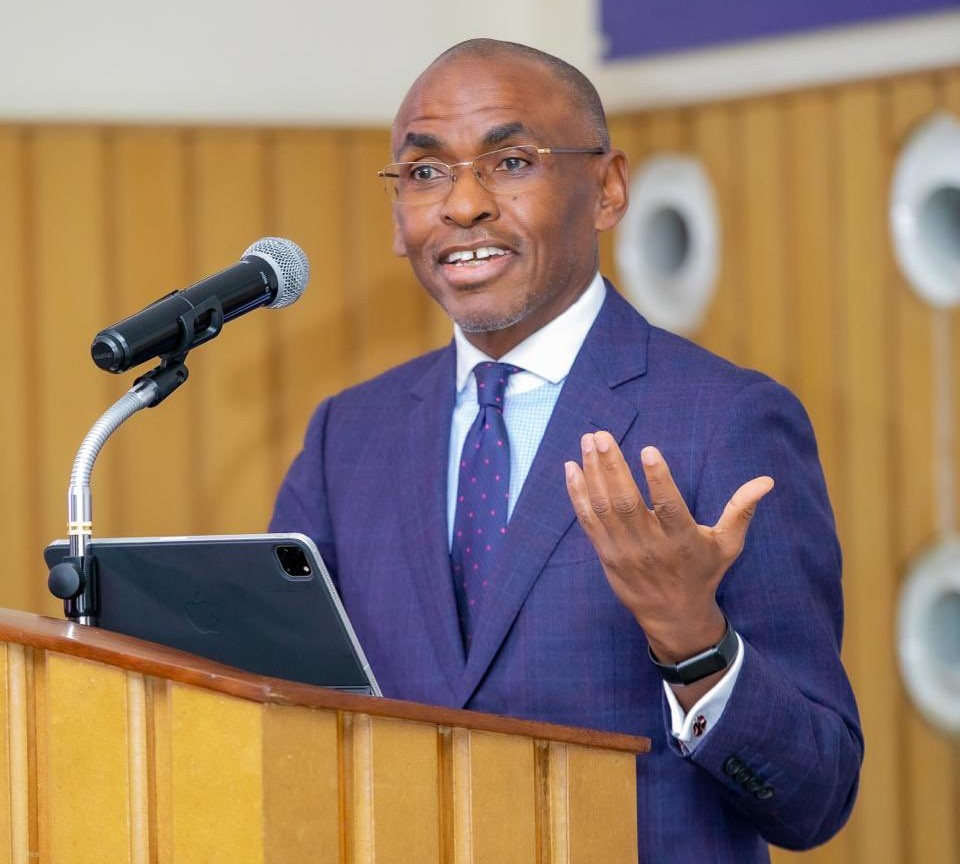
When Peter Ndegwa assumed the role of Group CEO of Safaricom PLC in April 2020, he inherited East Africa’s most profitable corporate entity at a time of unprecedented uncertainty. Six years later, the numbers tell the story of one of Africa’s most ambitious corporate transformations.
Under Ndegwa’s leadership, Safaricom has shifted from being primarily a telecommunications provider into a regional technology company driven by digital services, fintech, and geographic expansion.
Despite operating amid inflationary pressures, currency depreciation, and regulatory changes, Safaricom Group crossed the USD 3 billion revenue mark, reporting KES 414.1 billion in revenue in FY2026. Safaricom Kenya also became the first corporate entity in East Africa to surpass KES 100 billion in net earnings.
Central to this transformation has been the continued growth of M-PESA. Once a peer-to-peer payments platform, M-PESA has evolved into a digital financial ecosystem contributing between 40% and 44% of Safaricom Kenya’s service revenue while processing roughly 4,500 transactions every second for more than 41 million monthly active users.
The company has also deepened financial inclusion through products such as Lipa na M-PESA and Pochi la Biashara, supporting over 3.1 million businesses across Kenya.
Perhaps the defining strategic move of Ndegwa’s tenure has been Safaricom’s expansion into Ethiopia. Breaking into a market long dominated by a state monopoly, Safaricom Ethiopia has deployed more than 3,500 active network sites, acquired over 13.6 million customers, and extended coverage to nearly 60% of the country’s population.
A major milestone came with the acquisition of a financial services license from the National Bank of Ethiopia, paving the way for the launch of M-PESA Ethiopia and expanding digital financial access in one of Africa’s largest markets.
Over the six-year period, Safaricom navigated the COVID-19 pandemic, accelerated 4G and 5G deployment, invested heavily in AI-powered customer management systems, and successfully diversified away from traditional voice and SMS revenues.
By FY2026, mobile data had overtaken voice as Kenya’s largest connectivity revenue stream, signaling the company’s transition into a fully-fledged TechCo.
Today, with 71.6 million subscribers across its markets and an estimated contribution of about 8% to Kenya’s GDP, Safaricom’s evolution under Peter Ndegwa stands as a case study in large-scale digital transformation, platform economics, and regional expansion in frontier markets.

Email your news TIPS to Editor@Kahawatungu.com — this is our only official communication channel
