


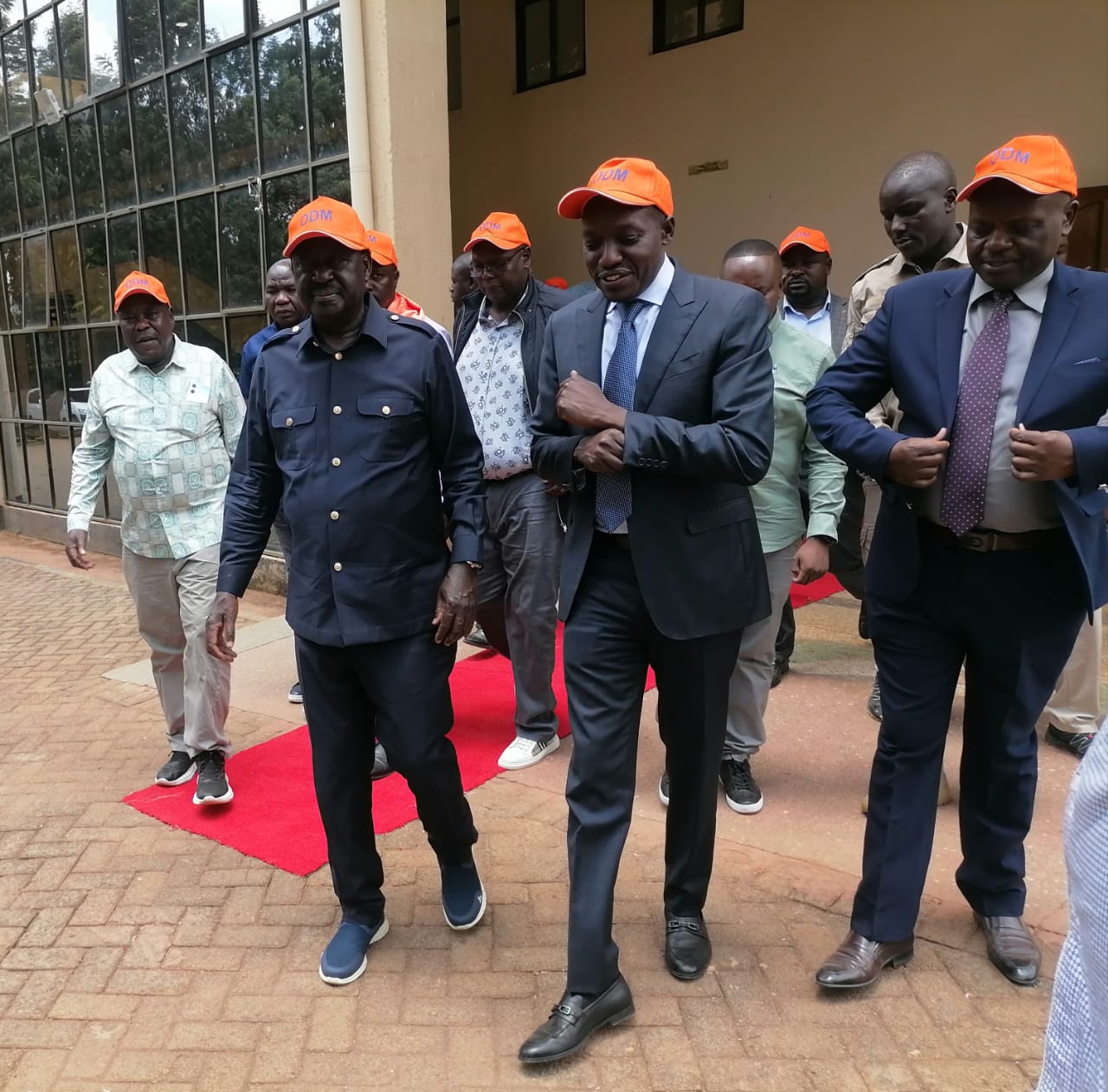
The Orange Democratic Movement is not facing a leadership contest. It is facing an existential question: does it want to survive as a political party, or does it want to become a permanent annex of the government it once opposed?
ODM has already made a historic decision. The party will not field a presidential candidate in 2027 and will instead back President William Ruto’s re-election bid. As one analysis put it, “Oburu Oginga’s ODM has made a historic gamble: The party will not field a presidential candidate in 2027 and will instead back Ruto’s re-election”. Party chairperson Gladys Wanga has confirmed this explicitly, saying ODM will support Ruto’s re-election bid if it secures the Deputy President position under a pre-election agreement. Arati himself has declared that the party would not accept anything less than a strict 50-50 arrangement and that the Deputy President slot is non-negotiable.
Whether one agrees with that strategy or not, it is now the party’s official position. The real question, therefore, is not who will be ODM’s presidential candidate—there won’t be one. The question is: who will lead ODM through this period of transition and position it to emerge as a strong, independent force after 2027?
My answer is Simba Arati.
The Generational Crisis: Why Sifuna and Babu Owino Left
Before making the case for Arati, it is worth examining why ODM has already lost some of its most talented young leaders—and what that tells us about the urgent need for generational change.
Edwin Sifuna, the Nairobi Senator, was ODM’s Secretary General from 2018 until his removal in February 2026. His ouster was orchestrated by the party’s establishment wing, which accused him of indiscipline and breach of protocol. His real offence? He had publicly criticised ODM’s cooperation with President Ruto’s administration. The Registrar of Political Parties ultimately ratified his removal in July 2026, concluding that the process complied with both the Political Parties Act and the party’s constitution.
And what has happened since?
Sifuna has become a presidential candidate. He has adopted The Equitable Party (TEP) as his political vehicle and was named its preferred presidential candidate for 2027. He is no longer tethered to ODM—he has become a national figure in his own right.
Babu Owino, the Embakasi East MP, was similarly pushed out. He has revealed that he formed his own political party, The Mwananchi Party, after realising ODM would not back his 2027 Nairobi gubernatorial ambitions. His break-up with ODM followed “growing differences over the Nairobi gubernatorial contest, with ODM moving closer to Sakaja as part of the broader political realignment”.
The lesson is clear. When ODM’s old guard pushes young leaders out, those leaders don’t disappear. They thrive—and they take a piece of ODM’s future with them. TIFA surveys show that roughly three-quarters of ODM’s own supporters back the Sifuna-Orengo Linda Mwananchi faction over the Oburu-Wanga Linda Ground. As the analysis in The Standard warned: “Parties rarely die when politicians quarrel, they die when leaders and voters begin telling different political stories. That divergence is already visible”.
If ODM continues on this path—elevating the same ageing faces and shutting out the next generation—it will not just lose elections. It will lose its identity.
Simba Arati is the answer to this generational crisis. He is not Sifuna or Babu—but he is the only leader within ODM’s current structures who can prevent more young talent from walking away.
At 44, Arati represents the generational shift that ODM desperately needs. Born on November 28, 1981, in Kisii County, Arati was elected as the Member of Parliament for Dagoretti North at just 29 years old, becoming the city’s youngest MP when he was elected in 2013. His rise was not through the party’s traditional patronage networks but through sheer grassroots appeal.
In the 2022 elections, he led a political revolution in the Gusii region, defeating veteran politicians who had dominated the area for decades. He garnered 270,928 votes against his closest rival’s 104,000. This was not just a victory; it was a statement that the old guard’s time was up.
Contrast this with the other contenders. Wycliffe Oparanya is 69. John Mbadi and Opiyo Wandayi are in their late 50s and 60s. Gladys Wanga is a strong leader but is seen as part of the establishment machinery that young voters increasingly reject. Only Arati combines youth with genuine executive experience and national mobilisation capacity.
Executive Experience Across Regions
Arati is the only contender who has successfully contested and won elections in two completely different political environments. He served as MP for Dagoretti North in Nairobi—a cosmopolitan, multi-ethnic constituency—from 2013 to 2022. He then won the Kisii gubernatorial seat on an ODM ticket. As Governor, his record speaks for itself.
A Politrack Africa assessment in April 2026 ranked Arati as the best-performing governor in the country, with Anne Waiguru and Wavinya Ndeti tied for second place. He was credited with infrastructural transformation, including tarmacking of roads, and investment in the healthcare system, including equipping and modernising Kisii Teaching and Referral Hospital. His administration launched state-of-the-art road construction machinery to transform the road network across all 45 wards. The county rolled out a KSh 315 million bursary programme for needy students. Kisii was even ranked first in the collection of its own-source revenue.
None of the other contenders can match this combination of electoral success in two regions and a nationally recognised record of service delivery.
The National Mobiliser
Arati has taken ODM politics far beyond the party’s traditional bases. He has led rallies across the country, demonstrating that he can energise crowds in regions where the party has historically struggled.
The Iten Breakthrough (December 2025): Arati led a massive convoy through Iten in Elgeyo Marakwet County—a region not known as an ODM stronghold. The town was brought to a standstill as enthusiastic supporters gathered to welcome him. He described Elgeyo Marakwet as the “County of Champions” and urged ODM supporters to remain united.
The Eldoret Rally (December 2025): Arati took his mobilisation drive to Eldoret, Uasin Gishu County, where he rallied fervent supporters and debunked talk of divisions in ODM ahead of 2027. He pledged loyalty to Party Leader Oburu Odinga while declaring that ODM has strong roots across the country.
The Nakuru Rally (November 2025): Addressing supporters in Nakuru, Arati affirmed that ODM would remain part of the broad-based government until 2027 while urging members to remain steadfast in their commitment to accountability. “We must reject corruption, even if we are in that broad-based government; justice must be done to every Kenyan,” he declared.
The Mombasa Rally (February 2026): Arati hosted the “Linda Ground” gathering at Tononoka Grounds in Mombasa, a strategic move to consolidate ODM’s support along the Coast.
The Kisumu Roadshow (May 2026): Thousands of ODM supporters flooded major roads in Kisumu as top party leaders embarked on a massive roadshow ahead of a highly anticipated rally at Kirembe Grounds. Arati was part of the leadership entourage alongside Party Leader Oburu Oginga, Kisumu Governor Anyang’ Nyong’o, and Migori Governor Ochilo Ayacko. The rally in Kirembe issued resolutions endorsing key party officials including Deputy Party Leaders Governor Simba Arati and Abdulswamad Nassir.
The Western Kenya Tour (January 2026): The “Linda Ground” mobilisation tour kicked off in Western Kenya with a delegates’ meeting at Kakemer in Malaba town, followed by a public rally.
The Kisii Mega-Rally (January 2026): Arati hosted Party Leader Oburu Oginga and a large section of elected leaders at Sameta Grounds in Kisii County. The meeting was organised to share the party’s resolution endorsing Oburu Oginga as Party Leader with grassroots members. Arati declared: “I want to promise all ODM supporters that ODM will form the next government. ODM is the biggest political party in Kenya and we can no longer be the opposition”.
The Kakamega Rally (January 2026): Arati addressed a rally in Kakamega where he openly accused CS Oparanya of fuelling divisions within the party instead of working to strengthen unity. He claimed the internal wrangles were weakening ODM at a critical moment and called on the Cabinet Secretary to work with the party’s county leadership rather than undermine it.
The Kibra Rally (January 2026): Addressing a rally at Kamukunji grounds in Kibra, Nairobi, alongside Oburu Oginga, Arati said they would hold dialogue with those opposed to the party’s decisions to resolve the standoff. “Everyone will play their role in the party,” he said.
The Malava Rally (July 2026): During a rally in Malava, Kakamega County, the demand for a 50-50 power-sharing arrangement with UDA hardened. Arati then addressed county chairpersons and party leaders in Nairobi, declaring the party would not accept anything less than a strict 50-50 arrangement.
This mobilisation capacity is critical. ODM has long been perceived as a regional party. Arati’s message is explicitly national, and his willingness to take the party’s message to every corner of the country is exactly what ODM needs if it is to survive as a national force after 2027.
The Nairobi Factor: Mastering Urban Politics
While Arati’s national rallies demonstrate his reach, his ability to mobilise in Nairobi deserves special attention—because Nairobi politics is fundamentally different from rural politics, and Arati is one of the few ODM leaders who genuinely understands both.
Why Nairobi is Different: Rural politics in Kenya often revolves around ethnic bloc voting, community elders, and long-standing patronage networks. Nairobi, by contrast, is a cosmopolitan, multi-ethnic, and youth-dominated political arena where voters are more issue-driven, more sceptical of ethnic appeals, and more responsive to grassroots mobilisation and tangible service delivery. Winning in Nairobi requires a different skill set: the ability to speak to diverse communities simultaneously, to navigate complex informal settlement politics, and to build coalitions across ethnic lines.
Arati’s Nairobi Credentials: Arati is not an outsider to Nairobi politics—he is a product of it. He served as the MP for Dagoretti North from 2013 to 2022, winning in a constituency that is far from a Gusii stronghold. His re-election in 2017 demonstrated that he could hold an urban seat in a competitive, multi-ethnic environment. This is a critical differentiator: none of the other ODM leadership contenders have won a competitive urban parliamentary seat outside their home region.
The Jacaranda Mobilisation: Arati’s ability to mobilise in Nairobi was demonstrated during the NASA era when he was one of the key organisers of the Jacaranda Grounds rallies. In 2018, police besieged his Nairobi home to prevent him from accessing Jacaranda grounds for a NASA memorial service. The response from Nairobi residents was telling: “wananchi came in their thousands” to support him. As he himself stated, “I am one of the planners and mobilisers of the Jacaranda rally.” This was urban mobilisation at its most potent—organic, youth-driven, and centred in Nairobi’s densely populated informal settlements.
The 2026 Nairobi Strategy: In August 2026, ODM convened a high-stakes consultative meeting in Nairobi, led by Arati alongside Party Leader Oburu Oginga and grassroots Nairobi officials. The meeting targeted youth leaders and branch executives, ensuring the party’s mobilisation architecture remained primed for the 2027 elections. His mandate explicitly involves “converting his Kisii regional influence into a national mobilisation engine, particularly targeting the urban youth demographic.”
Nairobi’s Strategic Importance: The capital city represents a critical battleground for ODM. Having lost the Nairobi gubernatorial seat to UDA’s Johnson Sakaja in 2022, the party leadership views the recapture of City Hall as a non-negotiable objective. Arati’s familiarity with Nairobi’s political terrain—its informal settlements, its youth networks, its multi-ethnic composition—makes him uniquely qualified to lead that recapture effort.
The Urban-Rural Bridge: What makes Arati particularly valuable is that he straddles both worlds. He can draw massive crowds in rural Kisii, Eldoret, and Iten, but he can also navigate the complex, issue-driven politics of Nairobi. This dual capability is rare in Kenyan politics. Most ODM leaders are either rural strongmen with limited urban appeal or urban politicians with shallow grassroots roots. Arati is both—and in a party that needs to win nationally, that combination is invaluable.
The Comparison: Why Arati Stands Out
Let us examine the alternatives.
Wycliffe Oparanya, the Cooperatives Cabinet Secretary and former Kakamega Governor, is one of ODM’s most experienced leaders. But at 69, he represents the old guard that the youth are increasingly rejecting. His influence is largely confined to Western Kenya. While he brings administrative experience, he lacks the national mobilisation energy that Arati possesses. Arati himself has publicly accused Oparanya of fuelling divisions within the party instead of working to strengthen unity.
Hassan Joho, the Mining Cabinet Secretary and former Mombasa Governor, is a charismatic and popular figure on the Coast. However, his appeal is regional, and he has spent the last several years as a Cabinet Secretary in a government that many ODM supporters view with suspicion. His base in the Coast, while important, is not sufficient to carry the entire party.
Gladys Wanga, the Homa Bay Governor and ODM National Chairperson, is a powerful voice for women and has emerged as a strong establishment figure. She has taken over as National Chairperson from John Mbadi. But her political base is firmly in Nyanza, and she is seen as part of the same establishment machinery that many youth feel alienated from. Her appeal beyond Nyanza remains untested.
John Mbadi, the Treasury Cabinet Secretary, is a seasoned political operator who has served as ODM Chairman and Minority Leader. But his current role in the Treasury ties him closely to the Ruto administration, and his recent declaration of intent to succeed Raila as the “Nyanza kingpin” has been met with resistance from other leaders. He lauded Sifuna’s removal from ODM, emphasising the need for party stability—a position that aligns him firmly with the establishment wing that young leaders are rejecting.
Opiyo Wandayi, the Energy Cabinet Secretary, is a competent technocrat with a strong parliamentary track record. But he is also tainted by his association with the broad-based government and has not demonstrated the grassroots mobilisation capacity that Arati has. His political base in Ugunja is relatively small, and he lacks a national profile.
In contrast, Arati combines youth, executive experience, national mobilisation capacity, and a proven ability to win elections in different regions. He is the only contender who has successfully contested and won both a Nairobi parliamentary seat and a governorship in a different region—and who has been ranked the best-performing governor in the country.
The most important thing to understand about ODM’s current situation is this: 2027 is not the prize. 2032 is.
ODM will support Ruto in 2027. That decision has been made. But what happens after 2027? As one analysis warned: “Ruto may be ODM’s lifeline and its undertaker simultaneously, preserving its machinery while eroding the distinction that made the machinery valuable”. If ODM simply becomes a junior partner in a Ruto government—absorbed, diluted, and indistinguishable from UDA—it will die.
The analysis in The Standard identified three possible futures for ODM: Absorption (Orange becoming a ceremonial wing of the Ruto machine—”Easiest now, deadliest later”); Coalition survival (supporting Ruto in 2027 while preserving independent structures and preparing for 2032—”The most realistic path”); and Reinvention (transforming a personality-driven vehicle into an ideological, internally democratic national party—”Hardest, but most consequential”).
The leader ODM needs is not someone who will manage absorption. It is someone who will pursue coalition survival and lay the groundwork for reinvention. Someone who will use the 2027–2032 period to rebuild the party’s independent identity, strengthen its grassroots structures, and prepare a new generation of leaders to contest power in 2032.
That is why Arati’s age matters. Oparanya, Joho, and the other veterans will be in their 70s by 2032. Arati will be 51. He is building for a future he will still be part of.
ODM retains structures, elected officials, and an Infotrak-measured national preference of 21 per cent—statistically level with UDA. A party commanding a fifth of national support is not finished. But it needs a leader who can convert that support into an independent political identity—not one who will trade it away for short-term access to State House.
This section is my own opinion and personal recommendation. It is not an official ODM position, nor is it a party resolution.
In my view, ODM needs a leadership team that balances experience with renewal, regional representation with national ambition, and respect for the old guard with space for the next generation. Here is what I would propose:
Party Leader: Simba Arati
As the face of the party, Arati brings youth, energy, national appeal, and unmatched grassroots mobilisation capacity. He is the only leader who can energise both rural and urban voters, and his track record in Nairobi and Kisii proves he can win in diverse environments.
National Chairman: Gladys Wanga
Wanga is a formidable political operator and a powerful voice for women. She has already taken over as National Chairperson. Elevating her to Chairman would recognise her contributions, maintain gender balance, and keep a key Nyanza leader at the heart of the party’s decision-making.
Deputy Party Leader (Coast): Abdulswamad Nassir
The Mombasa Governor is a rising star from a region that ODM cannot afford to neglect. He has already been endorsed as Deputy Party Leader in charge of Strategy. His inclusion would solidify the party’s support along the coast and bring fresh energy to the leadership.
Deputy Party Leader (Youth & Legacy): Winnie Odinga
Winnie represents the Odinga legacy and has emerged as a compelling voice for the party’s base. Giving her a role would ensure that the youth and the founding family’s legacy are both represented at the highest levels. This arrangement would appeal to both the party’s traditional supporters and the next generation.
Deputy Party Leader (Western): Paul Otuoma
Otuoma is a seasoned leader from Western Kenya who would bring regional balance and experience to the ticket. His inclusion ensures that a critical ODM stronghold feels fully represented.
Secretary General: John Mbadi or Opiyo Wandayi
Both are experienced administrators with deep knowledge of the party’s constitution and operations. Putting one of them in this role would ensure that the party’s internal machinery is in capable hands. The other could be offered a senior role in the 2027 government.
Honouring the Veterans
Rather than sidelining the party’s veterans, I believe Arati’s leadership should honour them and leverage their experience:
- Hassan Joho could be promised the Cabinet Secretary for Lands position in 2027. His popularity on the Coast and his administrative experience make him well-suited for this role.
- Wycliffe Oparanya could be promised the Cabinet Secretary for Finance position in 2027. His experience as a two-term governor and his current role as Cooperatives Cabinet Secretary make him an ideal fit for the country’s most important economic docket.
- Hassan Joho, Wycliffe Oparanya, and Anyang’ Nyong’o could be invited to join the ODM Elders Council, a prestigious advisory body that would allow them to continue shaping the party’s direction without engaging in divisive day-to-day politics.
This is my own personal recommendation. It is not a demand or a party resolution. It is simply a proposal I believe could help ODM present a cohesive front in 2027—and, more importantly, position itself to fight and win in 2032.
The Luo factor in ODM is inescapable. The party’s bedrock has always been Luo Nyanza, and the question of who leads the community—and the party—has been the source of intense rivalry since Raila’s passing. The current party leader, Dr. Oburu Oginga, Raila’s elder brother, was formally confirmed in March 2026 and is seen by many as the custodian of the Luo political legacy.
However, the sustainability of this arrangement is now in serious question. Oburu has been largely missing in action from ODM’s day-to-day leadership due to persistent health challenges. His office has confirmed that he is “well, safe, and in good spirits” but is under doctors’ instructions to “rest and limit heavy physical engagements”. ODM Director of Communication Philip Etale stated that Oburu “went to Nairobi Hospital for a routine check-up” and would “not be actively involved in politics for the next few weeks”. Oburu also travelled to the United Kingdom for a “routine medical checkup” in September 2026.
This absence has not gone unnoticed. Oburu missed several key party functions, including a three-day ODM retreat in Mombasa and the ceremony to dedicate Raila Odinga’s mausoleum in Bondo—an event of immense significance to the Odinga family and the party’s base. As one report noted, “a fresh jostling for influence in ODM is emerging as senior leaders move to assert themselves in the party during the prolonged absence of party leader Dr. Oburu Oginga from the public eye. Co-operatives Cabinet Secretary Wycliffe Oparanya, Homa Bay Governor Gladys Wanga and Kisii Governor Simba Arati have increasingly taken centre stage in party activities, each building a distinct political profile as ODM navigates the vacuum left by the death of party leader Raila Odinga”.
While ODM National Chairperson Gladys Wanga has insisted Oburu is “recovering steadily and remains in high spirits”, the reality is that the party cannot indefinitely defer the question of substantive succession. As The Standard noted: “The deeper problem is that political capital is not hereditary. Oburu has the name and pedigree; Wanga has administrative heft; none inherits Raila’s constituency by descent. It must be rebuilt”.
Arati’s position here is nuanced. He is not from Luo Nyanza, but he has demonstrated unwavering loyalty to the party’s leadership and has been a vocal defender of Oburu’s position as Party Leader. He has consistently called for unity, extending an olive branch to the rival Linda Mwananchi faction while firmly rejecting any attempts to undermine the party’s constitutional leadership. In January 2026, all speakers at the Kisii rally endorsed Simba Arati to accompany Oburu to the negotiation table, and Arati defended Oburu as the best fit to lead the party nationally.
His Gusii heritage could, in fact, be an asset. The Gusii community has historically been a crucial ODM support base, and Arati is arguably its most prominent political leader. A leader from outside Luo Nyanza but deeply embedded in the party’s broader coalition could help bridge the divide between the party’s Luo establishment and its other regional blocs. Importantly, Arati has been careful never to challenge the idea that the Luo community’s leader should emerge from within its own ranks; instead, he has positioned himself as a party leader for all Kenyans, not a communal one.
ODM does not need a leader who will simply manage decline. It needs a leader who can rebuild, expand, and win. Simba Arati offers that.
His youth makes him relatable to a generation that is increasingly disconnected from the old political order—a generation that watched Sifuna and Babu Owino walk away and thrive elsewhere. His record as the best-performing governor in the country demonstrates that he can govern effectively. His mobilisation across the country—from Iten to Eldoret, Nakuru to Mombasa, Kisumu to Malaba—shows that he can take the party’s message to every corner of Kenya. And his unique ability to navigate both rural and urban political landscapes, including the complex terrain of Nairobi, makes him the most complete political operator in the ODM leadership race.
The Luo factor cannot be ignored, but it need not be an obstacle. Arati has shown the wisdom to respect the party’s leadership structures while building his own national profile. He is not challenging the Luo community’s place within ODM; he is offering a vision in which ODM becomes truly national, with all communities having a stake.
The journey ahead for ODM will not be easy. Internal divisions, the shadow of the broad-based government, and the absence of Raila’s unifying presence are real challenges. But in Simba Arati, the party has a leader who can navigate these challenges with energy, vision, and a genuine connection to the people.
It is time for ODM to embrace the future. Simba Arati is that future.

Email your news TIPS to Editor@Kahawatungu.com — this is our only official communication channel
