


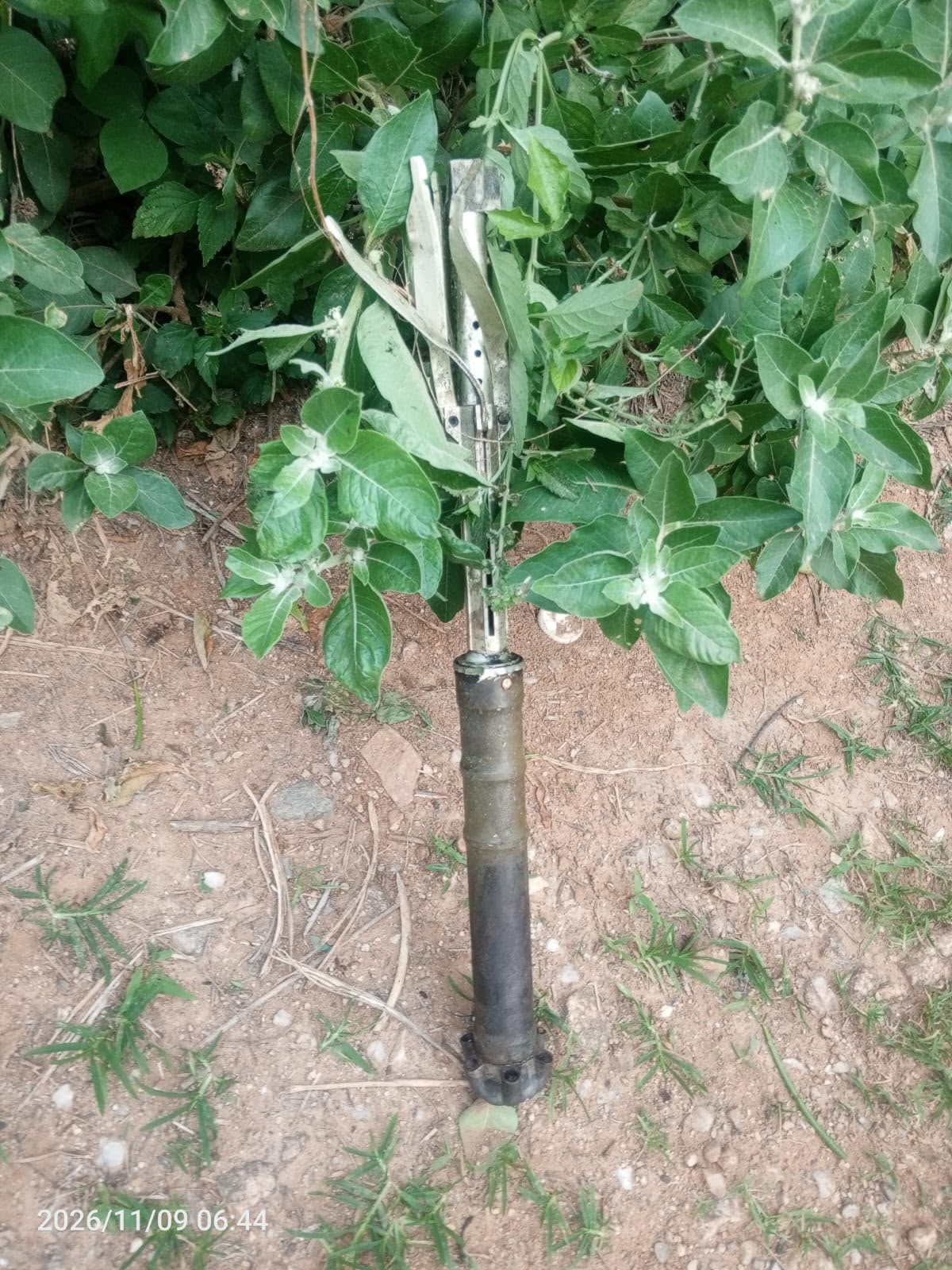
Kenya Defence Forces (KDF) officers safely detonated three rocket-propelled grenades (RPGs) discovered near the Kenya-Ethiopia border in the Sessi area of Moyale, Marsabit County.
The detonation was the second exercise in two weeks, officials said amid growing crisis.
The explosives, which had no visible registration markings, were destroyed on Monday, November 9, following reports that two RPGs had landed near a slaughter site close to the border.
The two explosives, fitted with stabilising fins at the rear, were reportedly fired from Ethiopia at around 2am Monday before landing a few metres inside Kenyan territory.
KDF officers based in Moyale carried out the controlled demolition at approximately 9.20am, with no injuries or property damage reported.
On their way back from the demolition site, the soldiers discovered a third RPG along the roadside near Sessi Mixed Secondary School.
The third explosive, which did not have stabilising fins, was also safely detonated.
Police said none of the three demolitions resulted in injuries or property damage.
Authorities said they had increased security personnel in the area to address the growing crisis. The explosives are being launched by rival groups targeting those seeking refuge in Kenyan side.
The government has confirmed that approximately 40,000 Ethiopians have crossed into Kenya and are currently being hosted in Moyale following escalating tensions in parts of Ethiopia.
Speaking about the ongoing situation, Mudavadi said tensions in Ethiopia had forced thousands of people to flee into Kenya.
“The issue is that from the Ethiopian side, they have been having a little bit of tension over there. So, the problem has caused about 40,000 people to evacuate to Kenya,” he said.
Mudavadi said he had communicated with his Ethiopian counterpart and asked him to intervene and help stabilise the situation so that the displaced families can return home.
“I told him to try and calm the situation in their country so that the refugees return to their homes,” he said.
He added that the Ethiopian government had assured Kenya that it was working to restore normalcy.
“They have assured us that they will do their best to return the issues to normalcy and then the people can go back,” Mudavadi said.
The displacement follows clashes that erupted in October 2026, amid longstanding disagreements between the Oromia and Somali regional administrations over territorial boundaries and administrative control.
The fighting has displaced thousands of people, with many families seeking shelter in schools, churches and temporary camps, while others have been accommodated by relatives and members of the local community.
Inspector General of Police Douglas Kanja ordered the deployment of additional police officers to Moyale, Marsabit County, amid growing security concerns linked to developments in neighbouring Ethiopia.
Kanja announced the reinforcement on November 5, during a security assessment visit to the border town, where he chaired a strategic meeting with regional security commanders to review the prevailing security situation.
He directed officers deployed in the area to remain on high alert and strengthen surveillance to protect residents and their property.
The Inspector General assured residents that the National Police Service (NPS) was committed to maintaining peace and stability in the region through enhanced security operations.
“We are here to ensure all the visitors and locals are safe. We will ensure more personnel arrive for protection,” he said.
He also urged members of the public to cooperate with security agencies by providing timely and relevant information that could help prevent security threats.
During the visit, Kanja toured a camp hosting families displaced by insecurity, where he assured them of enhanced protection and coordinated humanitarian assistance in partnership with relief agencies.
The security assessment comes amid concerns over instability in neighbouring Ethiopia and its potential implications for security along Kenya’s northern border.
Kanja was accompanied by Directorate of Criminal Investigations (DCI) Director Mohammed Amin, General Service Unit (GSU) Commandant Johanna Tonui and Kenya Police Service Director of Operations Philip Opiyo.
Others present included Eastern Regional Commissioner Jacob Muganda, Eastern Regional Police Commander Stephen Chebet, Eastern Regional Administration Police Commander Michael Owino and Regional Criminal Investigations Officer Michael Sang, alongside other senior security officials.
The visit came a day after a 20-year-old woman was seriously injured after being struck by two suspected stray bullets believed to have originated from neighbouring Ethiopia in Moyale, Marsabit County.
The incident occurred on November 4, 2026, at approximately 12:15pm while the victim was at her home in Biashara area.
Police said she was hit by two bullets in the back, leaving her unconscious.
She was rushed to Taqwa Nursing Home Hospital, where medical personnel removed the two bullets.
The victim was admitted in serious condition as police documented the incident.
The circumstances under which the bullets crossed into Kenyan territory remain unclear.
This is the latest such incident in the area amid growing crisis due to ongoing fighting in Ethiopia pitting two communities.
A 65-year-old woman was killed in the area, after she was reportedly struck by a suspected stray bullet believed to have originated from ongoing clashes in neighbouring Ethiopia.
The deceased was identified as Amina Guchi, who was reportedly at the Moyale County offices, located next to Moyale Law Courts, when the incident occurred on November 2, 2026.
Guchi was speaking to a security official on duty when an object believed to be a stray bullet struck her on the head from behind.
She collapsed and lost consciousness before being rushed to Moyale Sub-County Referral Hospital, where she was pronounced dead on arrival.
Police officers subsequently visited the hospital, where a post-mortem examination was conducted before the body was released to the family for burial arrangements.
Preliminary reports suggest the suspected bullet may have originated from ongoing fighting between two regions in Ethiopia, although the circumstances surrounding the incident remain subject to investigation.
The neighboring Moyale is experiencing conflict which has displaced more than 50,000 people.
Security officers in the area safely detonated three rocket-propelled grenades (RPGs) that reportedly landed in the area after being discharged from neighbouring Ethiopia.
The explosives were discovered on Sunday, November 1, 2026, following a report about unexploded explosive materials that had landed near Sessi Primary School.
This affected learning and examination at the centre.
Two Kenya Certificate of Secondary Education (KCSE) examination centres in Moyale Sub-County, Marsabit County, were relocated following the insecurity linked to clan clashes along the Kenya-Ethiopia border.
The decision was taken to safeguard candidates and examination personnel as the country entered the main phase of the 2026 KCSE examinations on Monday, with more than one million candidates beginning their written papers.
Education Cabinet Secretary Julius Migos Ogamba said the relocation demonstrated the Ministry of Education’s preparedness to respond swiftly to security threats and other emerging challenges that could disrupt the national examinations.
According to police, the explosives were found at two locations- one at Sessi Primary School and two others at the Meteorological Department offices.
Police and a team of bomb disposal experts from the Kenya Defence Forces (KDF) based at Odha rushed to the scene.
The security team established that the materials were three RPGs, which were subsequently secured, removed and safely detonated by the bomb experts.
At least three people had been injured after bullets hit structures in the area two weeks ago.
The United Nations refugee agency has warned of growing humanitarian needs in northern Kenya after an estimated 50,000 people fled clashes in Ethiopia and crossed the border into Moyale in search of safety.
The United Nations High Commissioner for Refugees (UNHCR) said significant cross-border movements had been reported since October 22, with the number of arrivals remaining fluid as registration and verification efforts continued.
Local authorities estimate that up to 50,000 people have entered Kenya, with reports indicating that additional crossings could further increase the number of people requiring assistance.
Many of those fleeing the violence are women and children, raising concerns over their protection and access to essential services.
The conflict started three weeks ago following the alleged raising of the flag of the Somali Regional State in Ethiopia, which triggered clashes between forces and groups from the Oromia and Somali regional states.
According to UNHCR, some arrivals are staying with relatives and host communities, while others have sought temporary shelter in schools and churches.
Food is the most urgent need, alongside safe drinking water, emergency shelter, sanitation and healthcare.
UNHCR has deployed an emergency team to Moyale to support the response and is working with the Kenyan government through the Department of Refugee Services and county authorities.
Other partners involved in the response include the International Organization for Migration (IOM), UNICEF, the World Food Programme (WFP), the Kenya Red Cross Society and other humanitarian agencies.
Humanitarian agencies are also conducting assessments to establish the protection and relief needs of those who have crossed the border.
The agency, together with UNICEF, IOM and WFP, is seeking $8.9 million to support up to 50,000 people who have fled Ethiopia into Kenya over the next three months.
The proposed funding will provide lifesaving assistance, including food, shelter, water and sanitation, as well as registration and protection services, particularly for children.
The agencies have warned that additional resources will be critical to ensuring that people fleeing the clashes can access basic necessities and protection while their immediate needs are assessed.

Email your news TIPS to Editor@Kahawatungu.com — this is our only official communication channel
