


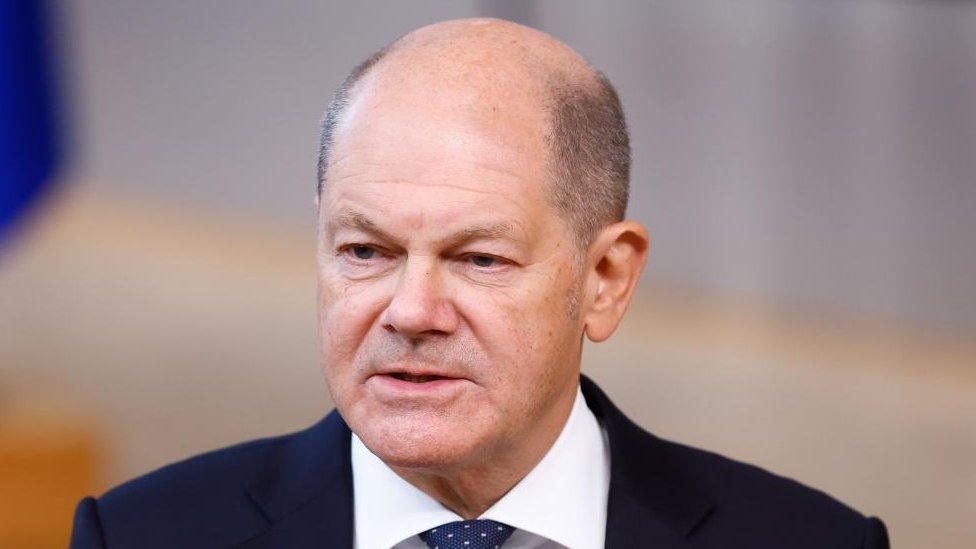
Olaf Scholz is a German politician and member of the Social Democratic Party of Germany (SPD) who served as the ninth Chancellor of the Federal Republic of Germany from December 2021 until May 2025.
Born on 14 June 1958 in Osnabrück, Lower Saxony, he grew up primarily in Hamburg’s Rahlstedt district after his family moved there.
His parents, Gerhard and Christel Scholz, both worked in the textile industry; his father rose from sales representative to managing director of various textile firms.
Scholz studied law at the University of Hamburg, specializing in labour and employment law, and later practiced as a lawyer.
He joined the SPD in 1975 at the age of 17 and has been married to fellow SPD politician Britta Ernst since 1998.
The couple has no children and has lived in Potsdam.
Scholz is the first non-denominational Chancellor of Germany, having left the Protestant Church as an adult while still acknowledging the cultural importance of Germany’s Christian heritage.
Siblings
Olaf is the eldest of three sons. His two younger brothers are Jens Scholz, born in 1959, and Ingo Scholz, born in 1961.
Jens Scholz is an anesthesiologist and medical professor who has served as chairman of the board (or CEO) of the University Medical Center Schleswig-Holstein since 2009; he has also been involved in research in anesthesiology, emergency medicine, and intensive care.
Ingo Scholz works in the IT sector in Hamburg, where he has held a position as a division manager or entrepreneur in a technology company.
The three brothers grew up together in Hamburg-Rahlstedt.
Career
Scholz’s political career began early through the SPD’s youth organization, the Young Socialists (Jusos).
Also Read: Bob Hawke Siblings: Get to Know Neil Hawke
He served as deputy federal chairman of the Jusos from 1982 to 1988 and as vice president of the International Union of Socialist Youth from 1987 to 1989.
After qualifying as a lawyer in 1985, he specialized in labour law while remaining active in party politics.
He entered the Bundestag in 1998 (serving until 2001 and again from 2002 to 2011, and once more from 2021).
Key roles followed: Interior Senator of Hamburg in 2001, SPD Secretary-General from 2002 to 2004, Federal Minister of Labour and Social Affairs from 2007 to 2009, First Mayor (governing mayor) of Hamburg from 2011 to 2018, and Federal Minister of Finance as well as Vice Chancellor under Angela Merkel from 2018 to 2021.
He led the SPD to victory in the 2021 federal election and formed a “traffic-light” coalition with the Greens and Free Democrats, becoming Chancellor on 8 December 2021.
His government addressed major challenges including the COVID-19 pandemic’s aftermath, the energy crisis, and Russia’s invasion of Ukraine, during which he announced a major shift in German defence and foreign policy known as the Zeitenwende.
After the coalition collapsed and early elections were held in 2025, Scholz’s term ended in May 2025; he was succeeded by Friedrich Merz.
He has continued as a member of the Bundestag.
Accolades
Scholz was named to Time magazine’s list of the 100 most influential people in the world in both 2022 and 2023, with the later citation highlighting Germany’s response to Russia’s war against Ukraine under his chancellorship, including increased military spending, arms support for Ukraine, and the end of reliance on Russian energy.
He was also awarded a Global Citizen Award in 2023.
In 2026, as former Chancellor, he received the Leo Baeck Medal from the Leo Baeck Institute in New York for his contributions to Jewish life and the preservation of German-Jewish history and culture in Germany.

Email your news TIPS to Editor@Kahawatungu.com — this is our only official communication channel
