


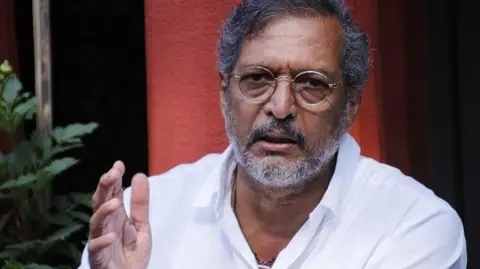
Veteran Indian actor Nana Patekar, known for his intense performances and distinct dialogue delivery, has died at the age of 75 in Goa, his son Malhar told BBC Marathi.
One of the most recognisable faces of Indian cinema, Patekar won three National Film Awards and became known for playing complex, often volatile characters. He was also a prominent figure in Marathi language cinema and theatre.
He was rushed to hospital after being found unconscious at his home in Goa in the early hours of Thursday.
“Despite 45 minutes of continuous CPR, he could not be revived,” Dr Shekhar Salkar of Manipal Hospital in Goa told ANI news agency.
On Thursday, Prime Minister Narendra Modi led tributes to the actor, praising Patekar’s versatility and outspoken personality.
Patekar portrayed characters that would “remain etched in the memory of generations”, Modi wrote on X, adding that his death had left “a vast void in the artistic world”.
Bollywood star Akshay Kumar, who appeared alongside Patekar in the comedy film Welcome, remembered him as a rare performer whose voice, intensity and honesty could command an audience’s attention.
Patekar made his debut with the film Gaman in 1978 and continued to play smaller roles in several films. But the intensity that he brought on the screen was hard to miss and soon he landed a role in Parinda in 1989, making him a household name across India. He won his first National Film Award and the Filmfare Award as well for his portrayal of the gangster Anna in the film.
He didn’t look back after this and played many memorable characters in several films through the 1990s. The range of the characters he played showcased the depth of his acting talent and mastery over his craft.
His portrayal of Major Chauhan in Prahaar – a film he also directed – won him praise. His other characters, including the patriotic hero of Tirangaa and Pratap Narayan Tilak in Krantiveer, also won him accolades.
Just when critics thought that playing loud characters was his mainstay, he proved them wrong by delivering a mesmerising performance in Khamoshi as a person who could not hear or speak.
Director Prakash Jha’s Rajneeti in 2010 added another dimension to his acting as his portrayal of an astute politician was delivered with perfection.
The breadth of Patekar’s career showcases the wide range of his work. He played different but contrasting roles like that of a notorious gangster or a policeman with equal ease. He also sometimes worked behind the camera as a director and writer.
His three national awards for Parinda, Krantiveer and Agni Sakshi are a also testament to his wide-ranging career.
Patekar was also an influential figure in both Marathi and Hindi theatre. Before making his debut in films, he was involved in theatre, where he developed his gritty style of dialogue delivery and also mastered the intensity he brought to his on-screen characters.
Purush and Hamidabai Chi Kothi were two of his most famous plays. Despite being successful in films, he remained active in theatre throughout his professional life.
Patekar was also known for his activism and didn’t mince his words while criticising the government of the day. He was direct, and almost brazen and unapologetic, when it came to criticising ministers and their policies and that too quite publicly.
Issues related to farmers were particularly close to his heart.
His work also went beyond just giving statements. In 2015 he and actor Makarand Anaspure established the Naam Foundation, which has worked on farmer welfare and water conservation in Maharashtra.
But his career was not without controversies.
In 2018, allegations of sexual harassment made by actor Tanushree Dutta against Patekar over an alleged incident on a film set a decade earlier helped spark India’s #MeToo movement. Patekar denied the allegations.
In 2019, he was cleared of the charges after police said they had not found sufficient evidence against him.
By BBC News

Email your news TIPS to Editor@Kahawatungu.com — this is our only official communication channel
