


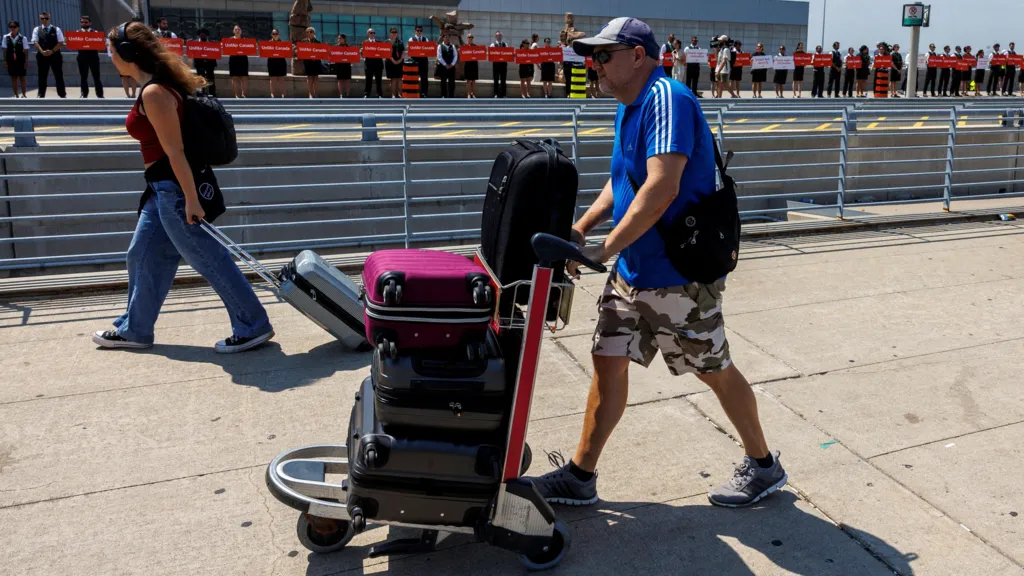
As Air Canada suspended “all operations” due to a flight attendant’s strike that began Saturday, the federal government has stepped in to force both parties to the bargaining table.
The attendants gave a 72-hour strike notice earlier this week, after contract talks reached an impasse.
Their union said the company was not addressing key issues such as wages and unpaid work, and the strike took effect shortly after midnight on Saturday.
Soon afterwards, the carrier began delaying and cancelling some flights. On Friday, it expected to scrap 500 flights, affecting 100,000 passengers.
With the strike in effect, the airline announced it would halt flights on its Air Canada and Air Canada Rouge service.
As the cancellations mounted, Canadian officials used their powers to force the airline and the union into binding arbitration, in an effort to minimise disruptions for travel and the economy.
Why is Air Canada cancelling flights?
The airline, which operates in 64 countries and has a fleet of 259 aircraft, warned that a “complete cessation of flying” would begin on Saturday, if the labour issues aren’t resolved. Air Canada Express flights, which carry about 20% of Air Canada’s daily customers, will not be affected.
Still, a shutdown could affect 130,000 daily customers, including 25,000 Canadians.
Upon receiving the strike notice, Air Canada issued its own 72-hour lock-out notice and began winding down operations, delaying and cancelling flights over those three days.
Chief Operations Officer Mark Nasr explained the airline’s system was complex and not something “we can start or stop at the push of a button”.
What led to the strike?
The Canadian Union of Public Employees (CUPE), representing 10,000 Air Canada attendants, has asserted that it bargained in good faith with the airline for more than eight months.
The airline said it recently offered flight attendants a 38% increase in total compensation over four years, with a 25% raise in the first year.
But the union said the offer was “below inflation, below market value, below minimum wage” and would leave flight attendants unpaid for some hours of work, including waiting at airports ahead of flights or guiding the boarding process.
They said that wages had not kept up with inflation, so that Air Canada’s suggested pay increase was “in effect, a pay cut”.
Almost all of the attendants – 99.7% – voted to strike earlier this month. The company, meanwhile, has asked the government to intervene.
Government representatives had facilitated some of the negotiations already, but the carrier went further and asked Canada’s jobs minister, Patty Hajdu, to refer the matter for binding arbitration.
How has the government responded?
On Saturday, Hajdu ordered Air Canada and CUPE into binding arbitration by invoking Section 107 of the Canada Labour Code.
“Despite significant supports from the government, these parties have been unable to resolve their differences in a timely manner,” Hadju said.
“I am exercising this authority because it is critical to maintaining and securing industrial peace, protecting Canadians and promoting conditions to resolve the dispute,” she said.
CUPE has responded by accusing the of Liberal Party of “violating our charter rights.” They allege that forcing a bargain to end the strike will “ensure unresolved issues will continue to worsen by kicking them down the road.”
Earlier this week, Air Canada proposed having a third party step in to develop an agreement through what is called “binding arbitration”, but the union rejected that.
It then asked the government to force the parties into binding arbitration, pointing to recent government interventions in rail, port and other negotiations.
In binding arbitration, an independent third party sets the terms of a contract in an agreement that is legally enforceable.
The union said in a statement on Friday that it had requested that Hajdu not intervene and, instead, allow “the parties to reach a resolution through free and fair negotiations, without undue interference”.
For the flight attendants, the only answer is for both sides to come back to the table.
There was growing pressure from other parts of Canada, as well. The Board of Trade for the Toronto region had called for a government intervention, while the province of Newfoundland and Labrador released a statement describing the impact of a strike as “catastrophic” for the tourism industry during the summer season.
How long will the strike last?
That’s unclear.
When Air Canada pilots went on strike in September 1998 for 13 days, all of the carrier’s more than 600 daily flights were grounded, stranding passengers and costing the airline C$133m ($96m; £71m) before a negotiated deal was reached.
In recent years, the federal government has stepped in during labour disputes by Air Canada workers by blocking strikes and imposing agreements.
Hadju’s intervention may alter the timeline for the two parties reaching an agreement.
The union said imposing arbitration would stop the first strike by the carrier’s flight attendants since 1985.
What to do if your flight is cancelled?
Air Canada has said it will notify passengers if there is a change to the flight’s scheduled departure time.
As of Saturday, Air Canada was “strongly advising” passengers not to go to the airport unless they had tickets on other airlines.
Customers whose flights are cancelled will be notified and receive a full refund, the airline said. The company has also made arrangements with other Canadian and foreign carriers to provide customers alternative travel options.
If it’s a round trip, return flights are not automatically cancelled in case the passengers reaches the destination.
Those bookings can be cancelled with no fees.

Email your news TIPS to Editor@Kahawatungu.com — this is our only official communication channel
