


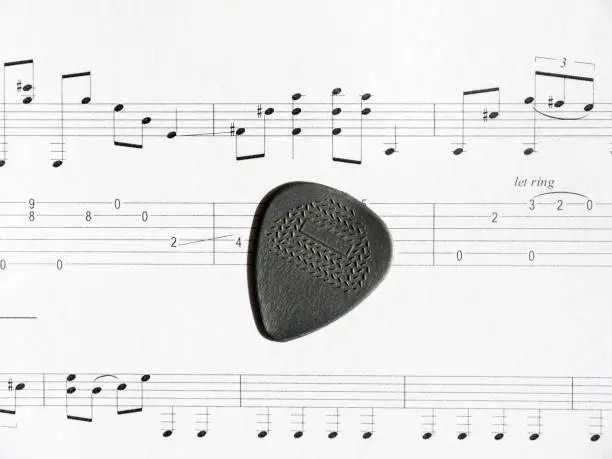
Learning how to read a guitar tab is a useful skill for beginners who want to play their favourite songs without having to read traditional sheet music. Guitar tablature, commonly called guitar tab, is a simple system that shows you where to place your fingers on the guitar strings and which frets to press. With a little practice, you can use guitar tabs to learn chords, riffs, melodies, and complete songs.
-
Understand the Six Lines
A guitar tab has six horizontal lines representing the six strings of a standard guitar. Each line corresponds to a string, and the lines are arranged from the thinnest string at the top to the thickest string at the bottom.
The strings are represented as follows:
- Top line: High E, the thinnest string.
- Second line: B string.
- Third line: G string.
- Fourth line: D string.
- Fifth line: A string.
- Bottom line: Low E, the thickest string.
Remember that the top line represents the highest-pitched string, while the bottom line represents the lowest-pitched string.
-
Learn What the Numbers Mean
The numbers written on the lines tell you which fret to press on that string. A zero means you play the string without pressing any fret, which is called an open string.
For example:
- 0 means play the string open.
- 1 means press the first fret.
- 3 means press the third fret.
- 5 means press the fifth fret.
If you see the number 3 on the bottom line, press the third fret of the low E string and pluck it.
-
Read the Notes from Left to Right
Guitar tabs are read from left to right, just like ordinary text. The numbers show the order in which you play the notes.
For example:
e|—————-|
B|—————-|
G|—————-|
D|—————-|
A|—–0–2–3—-|
E|—————-|
In this example, play the open A string first, followed by the second fret and then the third fret of the same string. Start slowly and maintain an even rhythm.
-
Understand Numbers Played Together
When numbers appear vertically aligned on different strings, they usually mean you should play those notes at the same time. This is how guitar tabs represent many chords.
For example:
e|—0—|
B|—1—|
G|—0—|
D|—2—|
A|—3—|
E|——-|
Play the indicated notes together to produce a C major chord. Place your fingers carefully and strum the five marked strings.
-
Recognise Common Guitar Tab Symbols
Guitar tabs often use symbols to show special playing techniques.
- h means hammer-on, where you sound a note by pressing another fret without picking again.
- p means pull-off, where you release a fretted note to sound a lower note.
- / means slide up to a higher note.
- \\ means slide down to a lower note.
- b means bend a string to raise its pitch.
- ~ means vibrato or a sustained, wavering pitch, depending on the tab.
Learn these symbols gradually as you become more comfortable playing basic notes.
-
Practise with Simple Guitar Tabs
Choose a beginner-friendly song or melody with a short tab. Tune your guitar correctly, identify the strings, and play each note slowly. Repeat difficult sections until you can play them smoothly.
You can also use a metronome to develop steady timing. Keep your fingers close to the fretboard and avoid pressing too hard.
Also Read: How to Give Access to a Word Document on Teams

Email your news TIPS to Editor@Kahawatungu.com — this is our only official communication channel
